Anne Carson: Why does tragedy exist?
Alex Zucker: Every time I think about international politics I want to smash something.
AC: Because you are full of rage.
AZ: No shit, Sherlock.
AC: Why are you full of rage?
AZ: Why do you think?
AC: Because you are full of grief.
AZ: Oh. [thoughtful pause] Is that it? I thought it was because of my self-righteousness, grounded in what John Bradshaw refers to as toxic shame.
AC: Ask a headhunter why he cuts off human heads. He’ll say that rage impels him and rage is born of grief. The act of severing and tossing away the victim’s head enables him to throw away all of his bereavements. Perhaps you think this does not apply to you.
AZ: No, I can see pretty well how it would apply to me.
AC: Yet you recall the day your wife, driving you to your mother’s funeral, turned left instead of right at the intersection and you had to scream at her so loud other drivers turned to look. When you tore her head off and threw it out the window they nodded, changed gears, drove away.
AZ: Um, actually, Anne, I don't recall anything of the sort. Are you sure you've got the right Alex?
AC: . . .
AZ: That's what I thought.
Sunday, May 11, 2014
Monday, December 30, 2013
Department of Czech Literary Yields, Continued
What We Saw in 2013 and What We’ll See in 2014
As I wrote in June, I’ve started a database of Czech lit in translation — not going all the way back, mind you, but just to keep track of what’s come out since the end of communism (I may also include a few books from ’89 and before, just for the sake of reference). It’s mainly for myself, but I figured there must be at least a few other people out there who are interested.
 |
| Random stack of Czech books from librarything.com |
Here’s what I’ve got so far: http://bit.ly/1dQfwDF. Please do write and let me know if you’re aware of any books I’ve missed.
And as far as I can tell, here’s what we’ve got to look forward to in English translation from Czech over the next 12 months (pub dates based on bookstore websites, rather than publishers’ sites, which aren’t always updated as often):
- February: Aaron’s Leap, by Magdaléna Platzová, trans. Craig Cravens (Bellevue Literary Press), and Marketa Lazarová, by Vladislav Vančura, trans. Carleton Bulkin (Twisted Spoon Press). [N.B. The latter has been pushed back several times from its original date of spring/March 2013, so whether or not the Feb. date will hold is anybody’s guess.]
- March: Rambling On: An Apprentice’s Guide to the Gift of the Gab, by Bohumil Hrabal, trans. David Short, and Of Mice and Mooshaber, by Ladislav Fuks, trans. Mark Corner (both Karolinum Press).
- May: Harlequin’s Millions, by Bohumil Hrabal, trans. Stacey Knecht (Archipelago Books), and Nightwork, by Jáchym Topol, trans. Marek Tomin (Portobello Books).
For those of you into statistics, note the expected yield for 2014 (six books) is 50 percent higher than it was this year (four books).


Tuesday, November 05, 2013
Czechs in New York Department
Němec, Klíma, Topol, Patočka — All in the Space of Eight Days
Czech it out. Czech list. Czeching in. Czech, please. Czech mate. Czech your head. Bouncing Czech. Time to bust out every stupid homophonic play on Czech you’ve ever heard, because starting this Friday, New Yorkers will be treated to a torrent of česká kultura the likes of which have seldom been seen.

- November 8–14: “Independent of Reality: The Films of Jan Němec,” Brooklyn Academy of Music. The first full-career U.S. retrospective of Czechoslovak New Wave enfant terrible Jan Němec. Twelve films in seven days. Curated by Irena Kovarova and produced by her new independent venture, Comeback Company.
- November 11: Czech author Ivan Klíma in conversation with László Jakab Orsós, director of the PEN World Voices Festival, discussing Klíma’s new memoir, My Crazy Century (Grove Press, translated by Craig Cravens). Czech Center New York, 7 p.m.
- November 14–16: Czech author Jáchym Topol at the New Literature from Europe festival, discussing his latest novel, The Devil’s Workshop (Portobello Books, translated by Alex Zucker). Nine authors, three days, three venues. Times and locations here. NOTE: Topol is confirmed only for the Nov. 15 and 16 events.
- November 15: “Heretical Europe: A Workshop on Jan Patočka’s Philosophy of History,” the New School, 10 a.m. to 6:15 p.m. A one-day workshop examining the legacy of Czech philosopher Jan Patočka, a giant of phenomenology and a co-founder of the Charter 77 human rights movement in communist Czechoslovakia. List of speakers here.
Wednesday, October 23, 2013
Czech Protest Department
Hanged-Man Figures Strung Up in Czech Cities Warn Against Dangers of Communist Party
A group calling itself Dekomunizace (Decommunization) strung hanged-man figures up on poles, bridges, and public buildings in cities around the Czech Republic Monday night to publicize the Communist Party's abuses in the past and warn against what might happen if it returns to power.
Czech voters go to the polls on Friday and Saturday, in early elections called as the result of a corruption scandal, and public opinion surveys show the Communists likely to take second or third place, which would give them posts in government.
The black figures were strung up with red-colored nooses in Hradec Králové, Jihlava, Tábor, and Prague. The inscription on their torso reads "Went against the KSČ(M)." [Photo gallery]
Czech voters go to the polls on Friday and Saturday, in early elections called as the result of a corruption scandal, and public opinion surveys show the Communists likely to take second or third place, which would give them posts in government.
The black figures were strung up with red-colored nooses in Hradec Králové, Jihlava, Tábor, and Prague. The inscription on their torso reads "Went against the KSČ(M)." [Photo gallery]
 |
| Protest figures hang above a campaign poster for the Communist Party that reads "With the people, for the people." Photo: František Vlček, MAFRA |
Though swept from power in the Velvet Revolution of 1989, the Communist Party of Czechoslovakia (KSČ) and its successor, the Communist Party of Bohemia and Moravia (KSČM), remained a legal political party with members in Parliament, and never distanced itself from the crimes and human rights abuses it committed during its 41 years in power.
Governments in other states of the former Soviet bloc banned the Communist Party after 1989.
In another protest action, artist David Černý, long known for his provocative work, installed a floating middle finger aimed at Prague Castle on the Vltava river on Monday.
Friday, October 18, 2013
Department of the History of Czech Literature Abroad
How Famous Czech Authors Got Famous: A Post on the Margins of ALTA 2013
Česká literatura v cizině / Czech Literature Abroad was a lengthy, substantial discussion online in 2012, and those who read Czech (or feel at home with Google Translate) will want to spend some time with it, but meanwhile here's an excerpt, in rough translation, from one of Paul Wilson's contributions to the discussion that sheds a lot of light on how it was that famous Czech authors actually came to be famous. Lots of food for thought here, for every literary translator, or editor of literary translations: http://bit.ly/1i0N2YU
 |
| Paul Wilson |
"It seems to me the primary question isn't whether readings or similar events, whomever they're sponsored by, are an effective way to promote Czech literature in the West or not, but how does today's book market work in the West, and whether it would even be possible for a new Kundera to appear in this situation. The old model, if that's the right word, was pretty clear. I don't know how it was with Kundera, but with all of 'my' authors there was someone in the West on their side, sometimes more than one person. Havel had the agent Klaus Juncker, then director Joe Papp in the U.S., Sam Walters in England, and I don't know who else he had in Austria or Germany. (Also don't forget the influence of his friendship with Stoppard. The first harbinger of Havel's fame was Kenneth Tynan's profile of Stoppard in the New Yorker in 1968, I believe, where almost half of it was about Havel.) These were all people who were fans of his, who believed in him and could give him support, help him, stage his plays, promote him, not just as a one-time thing, but for the long run. (Havel also had a 'court translator' in every language and they created his distinctive 'voice' abroad.) Ivan Klíma had, among others, Philip Roth, and then Bill Buford, when he was editor in chief of Granta, and they ushered him into the literary mainstream, situated him, found him a good publishing house that was willing to promote him, not just print his books, but 'publish' them and all that goes along with that, including proper editing and publicity, in short who devoted attention to him as one of 'their' authors who they intended to have a long-term relationship with — warm, friendly, deep relationships for the most part."
Friday, June 07, 2013
Department of Literary Yields
Czech Crop for English Readers in 2013
So far it looks like The Devil's Workshop (my translation of Jáchym Topol's most recent novel, published yesterday in the UK by Portobello Books) and Lord Mord (by Miloš Urban, translated by Gerald Turner for Peter Owen Publishers) may be the only works of Czech fiction appearing in English translation this year.
 |  |
Otherwise, according to the latest database of translations published by Chad Post on the Three Percent blog yesterday, there are no other books translated into English from Czech scheduled to appear this year. (Before anybody objects, I of course realize there is a Czech author on the list — Monika Zgustová — but she lives in Barcelona and wrote her novel The Silent Woman, due out in November, in Spanish.)
Major kudos to Mr. Post, by the way, for having had the foresight to start his lists. Without their existence, people like me would be less likely to do this kind of analysis, and the number of important debates and discussions they've given rise to is surely too many to count. Thank you, Chad! On the other hand, nobody's perfect, and there are a few Czech books missing from the list for 2013:
- Grove Atlantic is slated to publish Ivan Klíma's mammoth memoir, My Crazy Century, translated by Craig Cravens, in November. (Although this is a memoir, not fiction.)
- Twisted Spoon Press, in Prague, is supposed to bring out interwar giant Vladislav Vančura's classic novel Markéta Lazarová, in Carleton Bulkin's translation, although the originally scheduled pub date of spring (or March) 2013 has since been reported as May, then June, and it now seems to be due out in September. So we'll see.
- Finally, Jantar Publishing, in London, is planning to bring out two works this fall: Kytice, by Karel Jaromír Erben (bilingual edition, trans. Susan Reynolds), and The History Teacher, by Tereza Brdečková, trans. Elsa Morrison and Jan Čulík.
For comparison's sake, here are the numbers of works of Czech literature translated into English in the past five years (again, data from Three Percent):
2012: 4
2011: 2
2010: 5
2009: 6
2008: 5I did some research and came up with a few more past publications:
2012: –1 + 5 + 2
- Harlequin's Millions, by Bohumil Hrabal, trans. Stacey Knecht, Archipelago Books, was slated for publication in April 2012 but is now listed as due out in April 2014
- Václav Havel: Leaving and The Memo, trans. Paul Wilson; The Increased Difficulty of Concentration, trans. Štěpán Šimek; The Vaněk Plays, trans. Jan Novák; The Pig, or Václav Havel's Hunt for a Pig, trans. Edward Einhorn; all Theater 61 Press
- A Bouquet of Czech Folktales, by Karel Jaromír Erben, trans. Marcela Malek Sulak, Twisted Spoon Press
- On Flying Objects, by Emil Hakl, trans. Petr Kopet and Karen Reppin, Comma Press
2011: +2
- Prague, I see a city . . ., by Daniela Hodrová, and The Angel-maker, by Michal Mareš, both trans. David Short, Jantar Publishing
2010: +1
So the revised numbers would be:
- Gargling With Tar, by Jáchym Topol, trans. David Short, Portobello Books
2012: 10
2011: 4
2010: 6
2009: 6
2008: 5I did the best sleuthing I could, but if I've missed any books, I'll look forward to hearing about them! (P.S. I realize my labels are incomplete, but Blogger allows only a limited number of them.)
Friday, May 31, 2013
Rational Calculations Department
My Two Cents on Burma
"Attacks on Muslims in Myanmar" — nice of the Times to op-ed this. They are mistaken, though, in their invoking of the tired old bugbear of "old hatreds" (typically, when it comes to genocide, as in Rwanda and Yugoslavia, the favored variation is "ancient hatreds").
 |
| Image: http://arakanindobhasaa.blogspot.com/2011/11/bbc-under-fire-on-rohingyas.html |
One of the biggest obstacles to accurate understanding, and therefore effective prevention, of genocide is the failure to see it as a political phenomenon, i.e., a calculated decision on the part of a sector of society for the purpose of gaining (or regaining) power. The fact that "police and security officials," as the Times editorial board notes, "have been accused of failing to prevent attacks on minorities or being complicit in them," as well as the fact that the Rohingya Muslims are not the only minority who have been targeted — the Kachin, Karen, and Shan peoples have all been on the receiving end of violence and human rights violations by the Burmese government — should make it obvious that the country's rulers see a benefit in doing so.
If it's true that sanctions didn't help, it's also true that praising president Thein Sein for his progress on reforms while making no mention of the continuing massacres he's carrying out (described by Human Rights Watch last month as crimes against humanity), as Obama did last week when he welcomed him at the White House, is nothing but shameful and helps no one except the regime and the companies it does business with.
Wednesday, May 22, 2013
Department of Say What?
Bad Translation Makes Mexicans Think Prague Has Special Subway Cars for People to Have Sex
A slew of Mexican news sites reported over the weekend that a campaign to increase ridership on the Prague Metro included designating a car on each train where passengers could knock boots.
Metro.cz writes that the campaign, described in English here, will create a special car where singles can meet ("vagon, kde se budou moct lidé seznámit"), but that's as far as it's meant to go.
Some of the Mexican sites, like the one above, illustrated their stories with photographs from New York City's annual No Pants Subway Ride.
Filip Drápal of Ropid, the Prague transport company, is quoted as saying that nobody who enters the car will be forced to make contact with their fellow riders.
Other features of the campaign to induce Praguers to ride the Metro instead of driving their cars include concerts on the platforms and posters with quotes from Michal Viewegh novels and lyrics by pop rockers Mandrage.
A slew of Mexican news sites reported over the weekend that a campaign to increase ridership on the Prague Metro included designating a car on each train where passengers could knock boots.
 |
| Photo: vanguardia.com.mx |
Metro.cz writes that the campaign, described in English here, will create a special car where singles can meet ("vagon, kde se budou moct lidé seznámit"), but that's as far as it's meant to go.
Some of the Mexican sites, like the one above, illustrated their stories with photographs from New York City's annual No Pants Subway Ride.
Filip Drápal of Ropid, the Prague transport company, is quoted as saying that nobody who enters the car will be forced to make contact with their fellow riders.
Other features of the campaign to induce Praguers to ride the Metro instead of driving their cars include concerts on the platforms and posters with quotes from Michal Viewegh novels and lyrics by pop rockers Mandrage.
Saturday, May 11, 2013
Hues and Cries Department
Adam Hochschild, King Leopold's Ghost: A Story of Greed, Terror, and Heroism in Colonial Africa, 280–3:
An ancient English law made it a crime to witness a murder or discover a corpse and not raise a "hue and cry." But we live in a world of corpses, and only about some of them is there a hue and cry. True, with a population loss estimated at ten million people, what happened in the Congo could reasonably be called the most murderous part of the European Scramble for Africa. But that is so only if you look at sub-Saharan Africa as the arbitrary checkerboard formed by colonial boundaries. If you draw boundaries differently — to surround, say, all African equatorial rain forest land rich in wild rubber — then what happened in the Congo is, unfortunately, no worse than what happened in neighboring colonies [. . .]
 |
| Photos from King Leopold's Ghost |
Around the time the Germans were slaughtering Hereros, the world also was largely ignoring America's brutal counterguerrilla war in the Philippines, in which U.S. troops tortured prisoners, burned villages, killed 20,000 rebels, and saw 200,000 Filipinos die of war-related hunger or disease. Britain came in for no international criticism of its killings of aborigines in Australia, in accordance with extermination orders as ruthless as von Trotha's. And, of course, in neither Europe nor the United States was there major protest against the decimation of the American Indians.When these other mass murders went largely unnoticed except by their victims, why, in England and the United States, was there such a storm of righteous protest about the Congo? The politics of empathy are fickle. Certainly one reason Britons and Americans focused on the Congo was that it was a safe target. Outrage over the Congo did not involve British or American misdeeds, nor did it entail the diplomatic, trade, or military consequences of taking on a major power like France or Germany. [. . .]What happened in the Congo was indeed mass murder on a vast scale, but the sad truth is that the men who carried it out for Leopold were no more murderous than many Europeans then at work or at war elsewhere in Africa. Conrad said it best: "All Europe contributed to the making of Kurtz."
Friday, May 03, 2013
Department of Free Speech
Is it brave to tell someone to shut the fuck up when you're a celebrity standing on a stage and they're a nameless person sitting in the audience?
Or, more to the point: Is it wrong for the head of a free speech organization, a man who gives lectures on censorship, to tell a protester to shut the fuck up at a public event?
This was the question on my mind as I read about what happened at the opening event of this year's PEN World Voices Festival of International Literature, whose main theme is bravery.
According to the account on the PEN Live Tumblr:
If by "you" the protester meant PEN, the answer's a little murkier. A search of the word "Iraq" on the PEN American Center website turns up 16 pages of results—including "Rushdie mobilizes American writers against Bush," "Pamuk: Iraq war is the shame of US and West," "Resolution on the United States of America" (from the 2003 International PEN Assembly, censuring U.S. crackdowns on freedom of the press in connection with the war in Iraq), and "Sara Paretsky: Refusing to allow pressure to silence a critical voice"—but a search of press releases from Sept. 11, 2001, to March 19, 2003 (the date the U.S. invaded Iraq) returns no statement on the subject by the organization as such. Extending the search to Dec. 31, 2003, reveals "PEN protests Ashcroft comments on librarians, urges repeal of Patriot Act." That's it.
Of course there's a difference between being for a war and not being against it, but it seems to me both Rushdie and the protester could be found guilty of exaggerating their claims. (And again, there's the issue of power differential: Can an ordinary person speaking from the floor to the president of a national organization standing on stage honestly be accused of "bullying"?)
What I suspect, although the author of the PEN Live dispatch doesn't mention it, is the protester probably meant to direct his condemnation at neither Rushdie nor PEN, but a woman named Suzanne Nossel. [Note: At the time I wrote this, I had not yet received the photograph above. Now that I have it, it's clear the protester was referring to Nossel, not Rushdie. AZ, 5/4/13]
*****
In January the PEN American Center named Nossel as its new executive director. She comes to the job with some baggage, having lasted barely a year as executive director at Amnesty International USA, resigning in the wake of barbed accusations that Amnesty was guilty of "shilling for US wars."
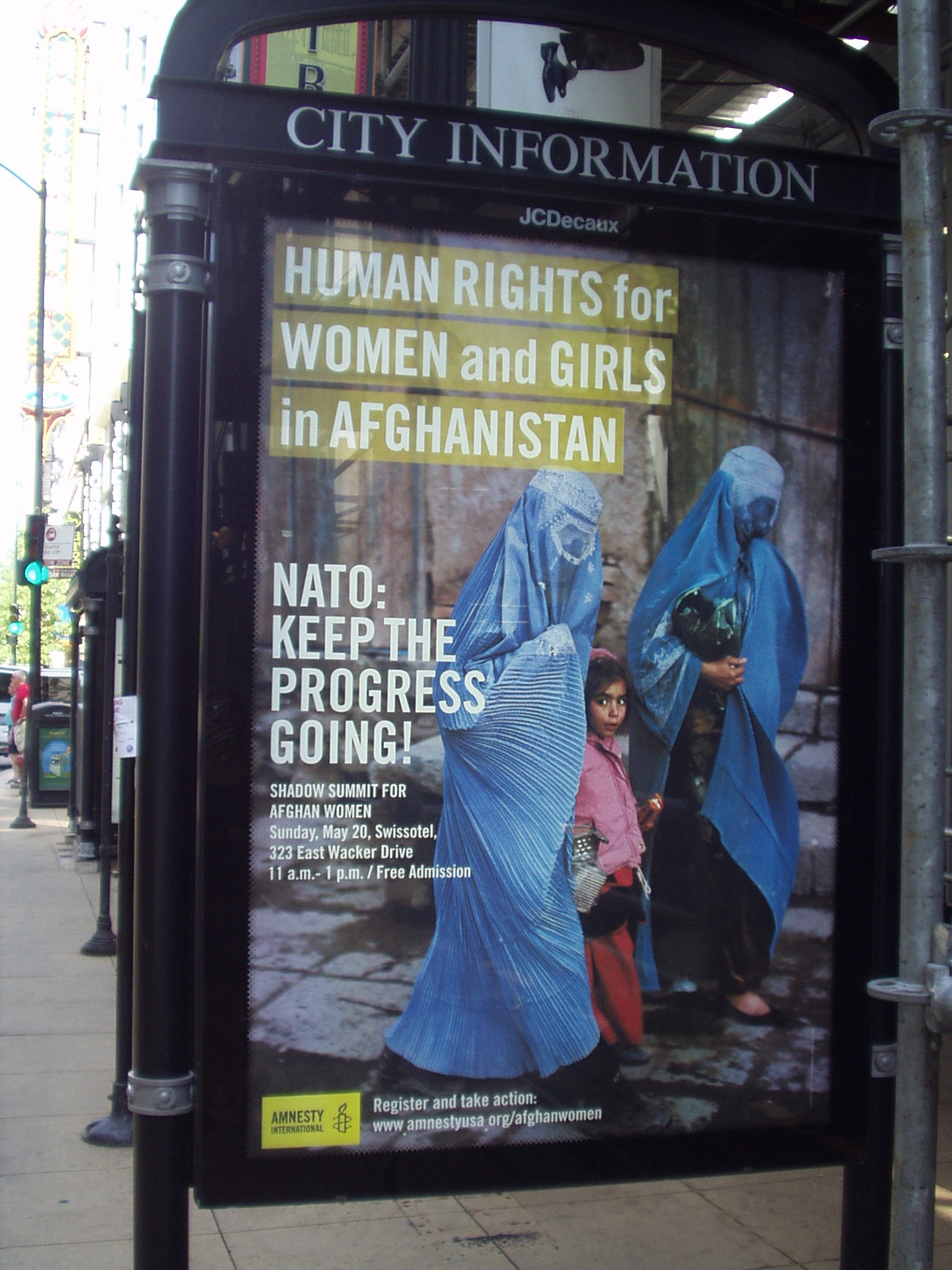
These charges stemmed primarily from an incident during Nossel's tenure last spring, when Amnesty placed ads on bus shelters in Chicago during the May 20–21 NATO Summit there, congratulating the military alliance for its contribution to human rights for women and girls in Afghanistan:
Simultaneous with the NATO event, Amnesty USA held a "Shadow Summit for Afghan Women's Rights," featuring former U.S. Secretary of State Madeleine Albright and speakers from the Afghan Women's Network and Women for Afghan Women, among others.
The outcry—both over the poster and at the inclusion of Albright, an advocate for the use of U.S. military force to stop atrocities and advance democracy—was loud enough that Amnesty felt obliged to respond. In a blog post titled "We Get It," AI USA's director of policy admitted that the poster was "confusing," but defended it, explaining:
Jodie Evans, a cofounder of Code Pink: Women for Peace, led a campaign asking the Amnesty board for Nossel's resignation. She attended the Shadow Summit in Chicago and during a Q&A session asked Nossel about the posters, as well as about reports that Nossel had let go staff from Amnesty's campaign to end the U.S. use of torture and close the detention camp at Guantánamo Bay. According to Evans,
I'm conscious of the need not to go too far astray here, but it's important to acknowledge that the debate about whether it's possible to promote human rights by military means—a matter of life and death most of all for the people on the receiving end of U.S. firepower—is as current now as ever, and Nossel, because of the jobs she has held and the statements she's made, both in print and in person, is right in the thick of it.
Nossel became a target for antiwar activists already in 2012, when she was hired as head of Amnesty USA. In contrast to her predecessor, Larry Cox—a lifelong activist with deep grassroots connections, whose involvement with Amnesty dated back to 1976—Nossel came to the job with a management background in both human rights (COO at Human Rights Watch) and corporate media (Dow Jones/Wall Street Journal and Bertelsmann), as well as a two-year stint in the State Department under Hillary Clinton, serving as deputy assistant secretary of state for international organizations.
The most trenchant criticism of Nossel has centered on her statements concerning U.S. foreign policy, beginning with an article she wrote for the establishment journal Foreign Affairs while at Bertelsmann, in 2004, titled "Smart Power." There is nothing terribly new about her argument, which can be boiled down to the idea that the United States, since the end of the Cold War, can no longer rely on military might alone to ensure its preeminent global standing: "trade, diplomacy, foreign aid, and the spread of American values" are equally valuable tools.
(The first person to put forward this position in U.S. policy circles was actually Joseph Nye, a political scientist at Harvard University, in a 1990 book titled Bound to Lead: The Changing Nature of American Power [his main argument is also summarized in this 1990 article for Foreign Policy]. The term Nye used was "soft power," not "smart power," but Nye, notably, was less interested in propping up U.S. hegemony than in "meet[ing] the challenges of transnational interdependence.")
Nossel casts herself as a Democrat, a "progressive" who wishes to "wrest . . . back from Republican policymakers" the tarnished doctrine of liberal internationalism, which argues that liberal states should intervene in other states to pursue liberal objectives. "Progressives," she writes in Foreign Affairs,
Most other criticism of Nossel at the time of her appointment as executive director of AI USA focused on her statements regarding Israel (which she was accused of defending at the expense of Palestinians' rights) and her stance vis-à-vis Iran (which she has argued Israel should attack preemptively).
This is not an exhaustive account of Nossel's credentials—far from it—and to be fair, Nossel has taken positions on other issues, and other countries, that are not at all controversial and have therefore gone unremarked. She's also the founder of a blog called Democracy Arsenal, a solidly liberal-Democrat forum that is entirely unexceptional in the range of opinion of its contributors.
The truth is, Nossel is squarely in the mainstream of present-day Democratic foreign policy thinking.
*****
Journalist and author Chris Hedges, who until recently most people knew mainly from his bylines in the New York Times, sprang more openly into the public eye in 2011, thanks to his engagement in Occupy Wall Street. Since then, he's become one of the go-to talking heads of the left, with a weekly column on Truthdig and regular appearances in the media and at public events.
In protest against the PEN American Center's hiring of Nossel, in April Hedges announced he was "resigning" from PEN and had turned down the organization's invitation to appear in this year's edition of the PEN World Voices Festival. In a follow-up to his announcement, "The Hijacking of Human Rights," he bludgeons Nossel, the U.S. government, and most of this country's largest human rights organizations for "buying into the false creed that U.S. military force can be deployed to promote human rights."
Nossel supported the U.S. invasion of Iraq in 2003: It's true. Hedges goes too far, though, in calling her "one of the most fervent cheerleaders for the Iraq War," claiming she "embraced the administration's policy, whether that's drone attacks, the assassination of U.S. citizens, the curtailment of civil liberties, had not spoken out against torture." Given that she was in the State Department for only two years (2009–11), and in a relatively low-profile position, I think his rhetoric is overblown.
The growing convergence of human rights and humanitarian aims with those of U.S. foreign policy—as documented and scrutinized in David Rieff's must-read A Bed for the Night: Humanitarianism in Crisis—is cause for great concern, and in Nossel these tendencies collide, but she, personally, is not responsible for them. The rising pitch of invective against her ("feminist for imperialism," "US imperial lackey," "war hawk") is out of proportion to her role in the matter.
But it is right to ask whether Nossel is an appropriate person to run the second-oldest human rights organization in the United States. (The PEN American Center was founded in 1922. The American Civil Liberties Union was founded in 1920. By the way, the PEN American Center claims that PEN International, founded in 1921, is the world's oldest human rights organization, but some quick web research reveals that that distinction rightly belongs to Anti-Slavery International, founded as the Anti-Slavery Society in 1839. PEN International itself, interestingly, does not make that claim.)
And it is right to point out, as Chris Hedges does, that on the U.S. government's treatment of whistleblower Bradley Manning, the PEN American Center, whose charter declares "that the necessary advance of the world toward a more highly organized political and economic order renders free criticism of governments, administrations, and institutions imperative," has remained silent (as has PEN International).
*****
Should Suzanne Nossel be replaced? I think so. I'm a member of PEN, and I believe we can do better. I also think the PEN American Center should join the Center for Constitutional Rights and the American Civil Liberties Union in standing up for Bradley Manning's constitutional rights.
According to a source who was at the Monday event, when the protester shouted "What about Bradley Manning?" Rushdie replied that PEN was working on it. Maybe. There's no evidence of it yet. Until there is, Salman Rushdie should watch his mouth.
Or, more to the point: Is it wrong for the head of a free speech organization, a man who gives lectures on censorship, to tell a protester to shut the fuck up at a public event?
 |
| Photo: Anonymous |
This was the question on my mind as I read about what happened at the opening event of this year's PEN World Voices Festival of International Literature, whose main theme is bravery.
According to the account on the PEN Live Tumblr:
The protester was wrong—if by "you" he meant Rushdie. Writing in the Washington Post in November 2002, Rushdie questioned the reluctance of "antiwar liberals" to recognize that "Saddam Hussein and his ruthless gang of cronies from his home village of Tikrit are homicidal criminals, and their Iraq is a living hell." But he cited several reasons why the U.S. war on Iraq was not justified and why he "remained unconvinced by President Bush's Iraqi grand design." He restated this position in a letter to the Guardian in 2007, adding that "as president of PEN American Center, I led that organisation in a number of campaigns against the Bush administration's policies."This is how the Opening Night Reading to PEN’s World Voices Festival of International Literature in The Great Hall of The Cooper Union started on Monday: Salman Rushdie walked on stage and said super eloquent things like, “The other meaning of courage is real artistic risk ... When we try and find new ways of saying things.”Then, a belligerent man with an anti-government sign yelled out, “You were for the war in Iraq!” He holds up his smartphone, “I have it right here in front of me! A war based on lies that killed a million people!” This guy was annoying everyone at the event.Rushdie’s calm, English-accented response: “The only lies being told here are by you, sir. As president of this organization, I led this organization against that war, so you can shut the fuck up. It doesn’t matter how you shout, sir. It doesn’t make what you say correct. That is the technique of the bully throughout history—to try and shout other people down.”With those words, and Rushdie’s cold-eyed stare hardened by assassination attempts and emboldened with knighthood, the man shut the fuck up. We continued on with the reading. It was an intense night, but in a good way.
If by "you" the protester meant PEN, the answer's a little murkier. A search of the word "Iraq" on the PEN American Center website turns up 16 pages of results—including "Rushdie mobilizes American writers against Bush," "Pamuk: Iraq war is the shame of US and West," "Resolution on the United States of America" (from the 2003 International PEN Assembly, censuring U.S. crackdowns on freedom of the press in connection with the war in Iraq), and "Sara Paretsky: Refusing to allow pressure to silence a critical voice"—but a search of press releases from Sept. 11, 2001, to March 19, 2003 (the date the U.S. invaded Iraq) returns no statement on the subject by the organization as such. Extending the search to Dec. 31, 2003, reveals "PEN protests Ashcroft comments on librarians, urges repeal of Patriot Act." That's it.
Of course there's a difference between being for a war and not being against it, but it seems to me both Rushdie and the protester could be found guilty of exaggerating their claims. (And again, there's the issue of power differential: Can an ordinary person speaking from the floor to the president of a national organization standing on stage honestly be accused of "bullying"?)
What I suspect, although the author of the PEN Live dispatch doesn't mention it, is the protester probably meant to direct his condemnation at neither Rushdie nor PEN, but a woman named Suzanne Nossel. [Note: At the time I wrote this, I had not yet received the photograph above. Now that I have it, it's clear the protester was referring to Nossel, not Rushdie. AZ, 5/4/13]
*****
In January the PEN American Center named Nossel as its new executive director. She comes to the job with some baggage, having lasted barely a year as executive director at Amnesty International USA, resigning in the wake of barbed accusations that Amnesty was guilty of "shilling for US wars."
These charges stemmed primarily from an incident during Nossel's tenure last spring, when Amnesty placed ads on bus shelters in Chicago during the May 20–21 NATO Summit there, congratulating the military alliance for its contribution to human rights for women and girls in Afghanistan:
 |
| Photo: http://blog.amnestyusa.org/asia/we-get-it/ |
Simultaneous with the NATO event, Amnesty USA held a "Shadow Summit for Afghan Women's Rights," featuring former U.S. Secretary of State Madeleine Albright and speakers from the Afghan Women's Network and Women for Afghan Women, among others.
The outcry—both over the poster and at the inclusion of Albright, an advocate for the use of U.S. military force to stop atrocities and advance democracy—was loud enough that Amnesty felt obliged to respond. In a blog post titled "We Get It," AI USA's director of policy admitted that the poster was "confusing," but defended it, explaining:
The shadow summit — and the poster — is directed at NATO, not to praise it, but to remind the leaders who will be discussing Afghanistan’s future this weekend about what is really at stake if women’s rights to security, political participation and justice are traded away or compromised.
We were thinking about the hard won gains Afghan women have made since the fall of the Taliban. Ten years ago, Afghanistan had one of the worst human rights records in the world in terms of women’s and girls’ rights. The Taliban banned women from working, going to school or even leaving home without a male relative.
Today, three million girls go to school, compared to virtually none under the Taliban. Women make up 20 percent of university graduates. Maternal mortality and infant mortality have declined. Ten percent of all prosecutors and judges are women, compared to none under the Taliban regime. This is what we meant by progress: the gains Afghan women have struggled to achieve over the past decade. [. . .]
As a matter of policy, Amnesty doesn’t take a position for or against NATO. We didn’t call for the bombing of Afghanistan — in fact, readers who were members or following our work when the bombing started in 2001 will remember that our message was “justice not revenge” and that we went into crisis response mode out of concern for the impact on civilians.
And we’re not calling for NATO to remain in the country. [emphasis in original]Sahar Saba, former spokesperson for the Revolutionary Association of the Women of Afghanistan (RAWA), founded in 1977 and supported by Amnesty in the past, argued that Amnesty was overstating the gains achieved by Afghan women since NATO entered the country in 2001 and that it was misleading to compare the current status of women with the situation under the Taliban.
Jodie Evans, a cofounder of Code Pink: Women for Peace, led a campaign asking the Amnesty board for Nossel's resignation. She attended the Shadow Summit in Chicago and during a Q&A session asked Nossel about the posters, as well as about reports that Nossel had let go staff from Amnesty's campaign to end the U.S. use of torture and close the detention camp at Guantánamo Bay. According to Evans,
Nossel said the signs [about NATO in Afghanistan] were a mistake but the intent was to talk about how the women were better off and to tell NATO they needed to keep the women safe. I replied that her messaging was still off, and that telling the audience of supporters of Amnesty that war is good for women was a horrible lie.*****
I'm conscious of the need not to go too far astray here, but it's important to acknowledge that the debate about whether it's possible to promote human rights by military means—a matter of life and death most of all for the people on the receiving end of U.S. firepower—is as current now as ever, and Nossel, because of the jobs she has held and the statements she's made, both in print and in person, is right in the thick of it.
 |
| Photo: http://www.pen.org/suzanne-nossel |
Nossel became a target for antiwar activists already in 2012, when she was hired as head of Amnesty USA. In contrast to her predecessor, Larry Cox—a lifelong activist with deep grassroots connections, whose involvement with Amnesty dated back to 1976—Nossel came to the job with a management background in both human rights (COO at Human Rights Watch) and corporate media (Dow Jones/Wall Street Journal and Bertelsmann), as well as a two-year stint in the State Department under Hillary Clinton, serving as deputy assistant secretary of state for international organizations.
The most trenchant criticism of Nossel has centered on her statements concerning U.S. foreign policy, beginning with an article she wrote for the establishment journal Foreign Affairs while at Bertelsmann, in 2004, titled "Smart Power." There is nothing terribly new about her argument, which can be boiled down to the idea that the United States, since the end of the Cold War, can no longer rely on military might alone to ensure its preeminent global standing: "trade, diplomacy, foreign aid, and the spread of American values" are equally valuable tools.
(The first person to put forward this position in U.S. policy circles was actually Joseph Nye, a political scientist at Harvard University, in a 1990 book titled Bound to Lead: The Changing Nature of American Power [his main argument is also summarized in this 1990 article for Foreign Policy]. The term Nye used was "soft power," not "smart power," but Nye, notably, was less interested in propping up U.S. hegemony than in "meet[ing] the challenges of transnational interdependence.")
Nossel casts herself as a Democrat, a "progressive" who wishes to "wrest . . . back from Republican policymakers" the tarnished doctrine of liberal internationalism, which argues that liberal states should intervene in other states to pursue liberal objectives. "Progressives," she writes in Foreign Affairs,
must therefore advance a foreign policy that renders more effective the fight against terrorism but that also goes well beyond it—focusing on the smart use of power to promote U.S. interests through a stable grid of allies, institutions, and norms. They must define an agenda that marshals all available sources of power and then apply it in bold yet practical ways to counter threats and capture opportunities. Such an approach would reassure an uneasy American public, unite a fractious government bureaucracy, and rally the world behind U.S. goals.For Nossel, human rights are more of an instrument than an end, a means to advancing U.S. interests: "Policymakers must pragmatically seek out opportunities for action where idealism and realism intersect and pursue their goals in ways that reinforce, rather than deplete, U.S. power."
Most other criticism of Nossel at the time of her appointment as executive director of AI USA focused on her statements regarding Israel (which she was accused of defending at the expense of Palestinians' rights) and her stance vis-à-vis Iran (which she has argued Israel should attack preemptively).
This is not an exhaustive account of Nossel's credentials—far from it—and to be fair, Nossel has taken positions on other issues, and other countries, that are not at all controversial and have therefore gone unremarked. She's also the founder of a blog called Democracy Arsenal, a solidly liberal-Democrat forum that is entirely unexceptional in the range of opinion of its contributors.
The truth is, Nossel is squarely in the mainstream of present-day Democratic foreign policy thinking.
*****
Journalist and author Chris Hedges, who until recently most people knew mainly from his bylines in the New York Times, sprang more openly into the public eye in 2011, thanks to his engagement in Occupy Wall Street. Since then, he's become one of the go-to talking heads of the left, with a weekly column on Truthdig and regular appearances in the media and at public events.
 |
| Photo: therealnews.com |
In protest against the PEN American Center's hiring of Nossel, in April Hedges announced he was "resigning" from PEN and had turned down the organization's invitation to appear in this year's edition of the PEN World Voices Festival. In a follow-up to his announcement, "The Hijacking of Human Rights," he bludgeons Nossel, the U.S. government, and most of this country's largest human rights organizations for "buying into the false creed that U.S. military force can be deployed to promote human rights."
Nossel supported the U.S. invasion of Iraq in 2003: It's true. Hedges goes too far, though, in calling her "one of the most fervent cheerleaders for the Iraq War," claiming she "embraced the administration's policy, whether that's drone attacks, the assassination of U.S. citizens, the curtailment of civil liberties, had not spoken out against torture." Given that she was in the State Department for only two years (2009–11), and in a relatively low-profile position, I think his rhetoric is overblown.
The growing convergence of human rights and humanitarian aims with those of U.S. foreign policy—as documented and scrutinized in David Rieff's must-read A Bed for the Night: Humanitarianism in Crisis—is cause for great concern, and in Nossel these tendencies collide, but she, personally, is not responsible for them. The rising pitch of invective against her ("feminist for imperialism," "US imperial lackey," "war hawk") is out of proportion to her role in the matter.
But it is right to ask whether Nossel is an appropriate person to run the second-oldest human rights organization in the United States. (The PEN American Center was founded in 1922. The American Civil Liberties Union was founded in 1920. By the way, the PEN American Center claims that PEN International, founded in 1921, is the world's oldest human rights organization, but some quick web research reveals that that distinction rightly belongs to Anti-Slavery International, founded as the Anti-Slavery Society in 1839. PEN International itself, interestingly, does not make that claim.)
And it is right to point out, as Chris Hedges does, that on the U.S. government's treatment of whistleblower Bradley Manning, the PEN American Center, whose charter declares "that the necessary advance of the world toward a more highly organized political and economic order renders free criticism of governments, administrations, and institutions imperative," has remained silent (as has PEN International).
*****
Should Suzanne Nossel be replaced? I think so. I'm a member of PEN, and I believe we can do better. I also think the PEN American Center should join the Center for Constitutional Rights and the American Civil Liberties Union in standing up for Bradley Manning's constitutional rights.
According to a source who was at the Monday event, when the protester shouted "What about Bradley Manning?" Rushdie replied that PEN was working on it. Maybe. There's no evidence of it yet. Until there is, Salman Rushdie should watch his mouth.
Sunday, December 04, 2011
Department of Realizations Arrived at Lying in Bed, Waiting to Fall Asleep
There is a part of me that does not believe another world is possible. But another part of me knows it's important for me to work with people who do.
Monday, March 08, 2010
Bookslut Smackdown Department

Jessa Crispin, aka Bookslut, who once upon a time ran a review of CSS, picks apart a new book by Spanish --> English translator Edith Grossman.
Wednesday, August 12, 2009
Department of Falling Walls
My death-defying contribution to the blog promoting the forthcoming Words Without Borders/Open Letter anthology The Wall in My Head. [Note: Original site no longer exists; link updated 5/13/13. Following is the text in full.]
08.05.09 | Quo Vadebas or "The Rubble in Our Heads"
by Alex Zucker
Martin M. Šimečka, primarily a journalist but known to most English speakers as author of the 1993 Pegasus Prize-winning novel The Year of the Frog, published a biting article last May on the Vienna-based site Eurozine titled "Still not free: Why post-'89 history must go beyond self-diagnosis." He begins:
By 1989, Šimečka writes, Adam Smith's invisible hand had "withered into a crippled stump." In Šimečka's homeland, Czechoslovakia (and its successors, Slovakia and the Czech Republic), the installation of capitalism through the 1990s—which is to say, the privatization of businesses, both large and small—was a frantic rush job, jury-rigged in such a way that it inevitably favored the powers that were, leaving most economic power in the hands of the nomenklatura, the "old structures," as they were colloquially known; or, hard to say for Slovaks and Czechs if this was worse or better, transferring it into the hands of foreigners, including the dreaded and envied Germans.
Meanwhile "the West" (whoever that means these days) had lost its moral mirror. No longer could opinion makers dwelling in democracy hold up the Havels and Michniks and Konráds as long-awaited proof of the kinder, gentler society that would necessarily bloom once intellectuals were finally lent the ear that they deserved.
Yet it is not Western naïveté that Šimečka is concerned with. It is the failure of Czechs and Slovaks and Poles and Hungarians themselves to be free, and to be free where it matters most: in their minds. As Šimečka puts it:
I saw this for myself during the five years I lived in Prague, from 1990 to 1995. During a night of drinking with Czech friends my age or older (that is, born prior to, say, 1965) at some point the conversation would invariably come around to what things used to be like in the bad old days. Not that it necessarily turned into a bitch-and-moan session; sometimes it got heavy; some of them had, after all, done time in prison. But as often as not there were laughs to be had in the reminiscing, a welcome relief from the pressure cooker of keeping up with the neck-snapping pace of life after the explosion of time (as Jáchym Topol referred to it). Whereas spending time with Czech friends who were younger than I was (born, say, 1970 or later), I rarely heard any discussion of the old times, unless it was about TV shows or bad pop music. Not that they were any less informed or intelligent than my older friends; they just weren't nearly as influenced by the past, as weighted down by it, for obvious and understandable reasons.
Of course, unfreedom comes in many guises. Many in "the West," including probably most of the people I know, would say that consumerism, marketing, and advertising are the main threats to a free-thinking mind nowadays. I myself have come to believe that whether or not I'm "free"—by which I mean free to make decisions in my own best interest, unharmful to myself or to others, based in love, not in fear—is less a question of my rights, or my exposure to manipulation by advertisers, or the scaremongering of government propaganda, or the diminishment of public space as corporations assume the functions of government (not to dismiss the significance of these things) than of my willingness to take responsibility for myself.
In other words, maybe for us—at least those of us in the United States, a country with a long and, to put it mildly, checkered tradition of seeking to "bring freedom" to other parts of the world—the 20th anniversary of the fall of the Berlin Wall is a good time for us to ask not how free or unfree are the people of Central Europe but how much freer or unfreer since then have we become?
08.05.09 | Quo Vadebas or "The Rubble in Our Heads"
by Alex Zucker
Martin M. Šimečka, primarily a journalist but known to most English speakers as author of the 1993 Pegasus Prize-winning novel The Year of the Frog, published a biting article last May on the Vienna-based site Eurozine titled "Still not free: Why post-'89 history must go beyond self-diagnosis." He begins:
"Some of you may recall the western hopes in the aftermath of the Velvet Revolution that central Europe could enrich the western political world with fresh new ideas, values or insights that it lacked; that perhaps central Europeans might come up with a vision of a 'third way' between capitalism and socialism. These hopes rested on the assumption that central Europeans' experience of suffering under communism had made us better human beings, more inquisitive, sensitive and intellectual. Today, that hope looks pathetic, and it has become clear that western perceptions of central Europe were truly naive."Šimečka, a Slovak who lives in the Czech Republic, argues that what at the time looked to many in the West like the fall of communism in Central Europe—a liberating event; the apotheosis of, depending on your background and point of view, Reagan's arms buildup and Star Wars missile defense shield or Gorbachev's glasnost or the grass roots stick-to-itiveness of the citizens on the far side of the Curtain (underestimated in nearly every account I've ever read), who, rather than try to break through the wall of Commie officialdom, simply stopped, turned heel, and walked away from it to form their own civil society—was actually no fall at all but a rise: the rise of globalization cum laissez-faire capitalism.
By 1989, Šimečka writes, Adam Smith's invisible hand had "withered into a crippled stump." In Šimečka's homeland, Czechoslovakia (and its successors, Slovakia and the Czech Republic), the installation of capitalism through the 1990s—which is to say, the privatization of businesses, both large and small—was a frantic rush job, jury-rigged in such a way that it inevitably favored the powers that were, leaving most economic power in the hands of the nomenklatura, the "old structures," as they were colloquially known; or, hard to say for Slovaks and Czechs if this was worse or better, transferring it into the hands of foreigners, including the dreaded and envied Germans.
Meanwhile "the West" (whoever that means these days) had lost its moral mirror. No longer could opinion makers dwelling in democracy hold up the Havels and Michniks and Konráds as long-awaited proof of the kinder, gentler society that would necessarily bloom once intellectuals were finally lent the ear that they deserved.
Yet it is not Western naïveté that Šimečka is concerned with. It is the failure of Czechs and Slovaks and Poles and Hungarians themselves to be free, and to be free where it matters most: in their minds. As Šimečka puts it:
"All of us who lived at least part of our adult lives under communism have been marked by the past to the extent that we may never be able to discuss it in the language of a natural, free world. We may be able to distinguish between the courageous from the cowardly and victims from culprits, but not between those who are free and those who are not. The category of a free human being simply did not exist under the communist regime. Defiance, resistance or attempts to live a parallel life outside the system may have represented signs of longing for freedom but they did not represent freedom itself. This is why we can and we should bear witness and many deserve admiration and respect for their courage. Yet this does not entitle us to claim that we can interpret this part of history in a free and unbiased way. We are all like patients who self-diagnose and prescribe their own treatment."And Šimečka believes that the first place freedom can happen (for it has not happened yet) will be in the rewriting of this part of Europe's history. It is up to the generations with no experience of communism to interpret the past free of personal anger, bitterness, and resentment, as well as of deserved if at times excessive respect and deference toward the members of the generations who swam in it—who sank or swam in it—from the day they were born. In other words, the first freedom will come from the ones with no Wall in their heads, the ones with their heads free of rubble.
I saw this for myself during the five years I lived in Prague, from 1990 to 1995. During a night of drinking with Czech friends my age or older (that is, born prior to, say, 1965) at some point the conversation would invariably come around to what things used to be like in the bad old days. Not that it necessarily turned into a bitch-and-moan session; sometimes it got heavy; some of them had, after all, done time in prison. But as often as not there were laughs to be had in the reminiscing, a welcome relief from the pressure cooker of keeping up with the neck-snapping pace of life after the explosion of time (as Jáchym Topol referred to it). Whereas spending time with Czech friends who were younger than I was (born, say, 1970 or later), I rarely heard any discussion of the old times, unless it was about TV shows or bad pop music. Not that they were any less informed or intelligent than my older friends; they just weren't nearly as influenced by the past, as weighted down by it, for obvious and understandable reasons.
Of course, unfreedom comes in many guises. Many in "the West," including probably most of the people I know, would say that consumerism, marketing, and advertising are the main threats to a free-thinking mind nowadays. I myself have come to believe that whether or not I'm "free"—by which I mean free to make decisions in my own best interest, unharmful to myself or to others, based in love, not in fear—is less a question of my rights, or my exposure to manipulation by advertisers, or the scaremongering of government propaganda, or the diminishment of public space as corporations assume the functions of government (not to dismiss the significance of these things) than of my willingness to take responsibility for myself.
In other words, maybe for us—at least those of us in the United States, a country with a long and, to put it mildly, checkered tradition of seeking to "bring freedom" to other parts of the world—the 20th anniversary of the fall of the Berlin Wall is a good time for us to ask not how free or unfree are the people of Central Europe but how much freer or unfreer since then have we become?
Tuesday, June 16, 2009
New Czech Drama Department

Last night marked the release of Czech Plays: Seven New Works, published by the Martin E. Segal Theatre Center of CUNY. Buy it here.
It contains a play by Iva Klestilová Volánková, called Minach, that I originally translated for the Czech Center New York's staged reading series in 2002. (Not to too blatantly hype myself, but you can also buy a copy of Minach separately from the Theatre Institute in Prague.)
Friday, November 18, 2005
Department of Unexpected Poignancy
A couple weeks ago, I was revisiting Jim Jarmusch's first film, Stranger Than Paradise. My father wandered into the room, as he is wont to do whenever someone is watching a movie and he comes upstairs from his study to take a break from work, and so he watched for a while, and was asking about it. So I was explaining who Jim Jarmusch is, and said that I thought his best film, and one I am sure my dad would like, is Down by Law.
And so the other day, when I was in the library, I noticed they had Down by Law on DVD, so I checked it out and brought it home for my dad to watch if he wanted. Well, who knows if he'll watch it or not, but *I* decided to watch it (I'm watching it at this moment in fact) on this, my last night in Ann Arbor.
But this is my point. When the opening sequence came up, it suddenly dawned on me that this is a *New Orleans* film; and especially the opening sequence. It's long been one of my favorite openings -- for the cinematography (black & white, slow-mo, and wide angle) as well as for the music ("Jockey Full of Bourbon," by Tom Waits) -- but the poignant moment for me came as it suddenly dawned on me that everything in that sequence must now be gone. Forever. In effect the film has been transformed from feature to documentary (as, no doubt, many others have as well; in this, of course, Down by Law is not unique). And, well, I found that poignant.
And so the other day, when I was in the library, I noticed they had Down by Law on DVD, so I checked it out and brought it home for my dad to watch if he wanted. Well, who knows if he'll watch it or not, but *I* decided to watch it (I'm watching it at this moment in fact) on this, my last night in Ann Arbor.
But this is my point. When the opening sequence came up, it suddenly dawned on me that this is a *New Orleans* film; and especially the opening sequence. It's long been one of my favorite openings -- for the cinematography (black & white, slow-mo, and wide angle) as well as for the music ("Jockey Full of Bourbon," by Tom Waits) -- but the poignant moment for me came as it suddenly dawned on me that everything in that sequence must now be gone. Forever. In effect the film has been transformed from feature to documentary (as, no doubt, many others have as well; in this, of course, Down by Law is not unique). And, well, I found that poignant.
Sunday, November 13, 2005
Department of Waiting for Comment from Charles Barron
Here are links to three other stories (one, two, three) that illuminate the title of this posting.
For more information about Zimbabwe, visit this site. Please note, however, that the one I present here (chosen entirely at random, using a Google search) is hardly the only one. There are many other sources that document just as well the horrors of present-day Zimbabwe and the vicious, lying rule of its president, Robert Mugabe.
November 13, 2005
In Zimbabwe, Homeless Belie Leader's Claim
By MICHAEL WINES
BULAWAYO, Zimbabwe - President Robert G. Mugabe has one word for reports that Operation Drive Out Trash, the urban-demolition campaign aimed at slum dwellers that his government describes as a civic beautification program, has rendered thousands of his impoverished citizens homeless.
"Nonsense," he told ABC News in an interview broadcast on Nov. 3. "Thousands and thousands and thousands and thousands. Where are the thousands? You go there now and see whether those thousands are there. Where are they? A figment of their imagination."
Clearly, Mr. Mugabe has not been to Bulawayo.
Just three miles west of the center of Bulawayo, Zimbabwe's second-largest city, Robson Tembo and his wife, Ticole, live in the open air in a small pen, 12 feet by 12 feet, built of deadwood and scrap. Rows of plastic grocery sacks hold the assets they have collected over 72 years.
Five miles north, Nokuthula Dube, 22, her two daughters and two orphaned relatives are squatting in an unfinished two-room house of cinder blocks. During a reporter's recent visit, an unidentified woman lay curled up on the concrete floor of the house's only closet, sleeping.
On the other side of town, Gertrude Moyo, 28, lives with her four children and seven other families in tents, pitched in the bush.
More than simple homelessness binds the three families. Until a few months ago, they all lived in Killarney, a shantytown with an improbable name that had housed Bulawayo's less fortunate citizens since the early 1980's.
Today, Killarney is a moonscape of sunbaked dirt, scrub and burned-out rubble. Last May and June, police officers reduced its huts to wreckage, burned their remains and routed the area's more than 800 residents as part of Operation Drive Out Trash.
"They had iron bars as long as this," Mr. Tembo said of the police, stretching his arms wide. "They demolished part of every hut, and then they told us to destroy the rest."
Mr. Tembo said he refused, and so the police finished the job, leveling his two-room home built of wooden poles and metal walls.
More than five months after the demolitions began, Zimbabwe's government continues to insist that the destruction of 133,000 households, by its own count, was a long-overdue slum-clearance effort that has caused its citizens only temporary inconvenience.
The government contends that most of those made homeless have been relocated to the rural villages where they lived before migrating to the cities, mostly to look for work. Others, it says, will be placed in thousands of new homes being built to replace the illegal huts that have been razed.
Mr. Mugabe has rejected the United Nations' attempt to raise $30 million to aid the victims of Operation Drive Out Trash on the ground that Zimbabwe has no crisis. Despite a public appeal by Secretary General Kofi Annan on Oct. 31, the government so far has rejected any assistance that implies that its evicted citizens are in distress.
Yet many are in great distress. Relying on the estimates of Zimbabwe's government, the United Nations says 700,000 people were displaced by the May and June demolitions and a later campaign, Operation Going Forward, No Turning Back, in which police officers routed those who tried to return to the cities and rebuild.
An August survey of more than 23,000 Zimbabwean households by the South Africa-based advocacy group ActionAid International places the number of those made homeless as high as 1.2 million - more than 1 in 10 Zimbabweans.
Where many have gone is a mystery. The government carted thousands to holding camps that were later disbanded, and transported thousands more by trucks into the countryside and left them there, ostensibly near their rural homes. Those people are registered with local officials, but almost certainly, they are but a fraction of the total.
In the Nkayi district, a vast expanse of bush terrain north of Bulawayo with 110,000 people, fewer than 700 families are known to have been relocated, according to church officials involved in assisting them.
Similarly, the government's home-building plan has fallen far short of its promises and of the demand. Mr. Mugabe pledged three trillion Zimbabwe dollars for construction in July - about $30 million in American dollars, and dropping steadily given Zimbabwe's 400 percent inflation rate. But the national treasury is all but bare, and in Bulawayo, where 1,000 homes were promised in short order, fewer than 100 are being built.
So where are the homeless?
"This remains what I'd call an invisible humanitarian crisis - invisible to international eyes, the reason being that those who were displaced have been dispersed," said David Mwaniki, who oversees ActionAid's work in Zimbabwe.
Many are probably with relatives; a few have fled the country. Others are in the bush, surviving off the kindness of neighbors. Many more have vanished into hovels and tents and half-built houses.
The United Nations says 32,000 of Bulawayo's 675,000 residents lost their homes and were ordered to leave the city during the demolition campaign; city officials put the number at 45,000. Torden Moyo, who directs an alliance of local civic groups called Bulawayo Agenda, says there is no doubt where they have gone.
"Ninety-five percent are now back," he said. "They're still struggling, still homeless, still penniless, still shelterless. They've been made refugees in their own country."
Killarney is proof of that. Before the demolitions, it was dirt-poor but thriving, subdivided into three villages with stores and services. All that has been razed and burned. Northeast of town, not far off the road to Bulawayo's airport, Nokuthula Dube, her own children and an orphaned niece and nephew share the two rooms of a half-finished home. Ten stunted cornstalks and some greens grow in a makeshift plot outside, but the five live on donated cornmeal from a nearby church.
Ms. Dube returned from her niece's school in June to find her home in Killarney's Village One wrecked and on fire. Homeless and pregnant, she lost her housecleaning job in a nearby suburb. Her husband, Nomen Moyo, had to move away to keep his job as a gardener. Ms. Dube said she and the children walked for a week, sleeping by the road, before finding the shell where they now live.
In September, Ms. Dube had a daughter, Mtokhozisi. She left her 3-year-old daughter, Nomathembe, and the two orphans - 10-year-old Pentronella and 14-year-old Kevin - alone while she gave birth in a local hospital. She walked home from the hospital with her newborn. "I left in the morning," she said, "and arrived around 3."
A few weeks ago, a man who said he was the house's owner appeared. "He wants us to leave," she said. "He's claiming that this is his house."
Asked where they would go, she said, "Only God knows."
Across town, Gertrude Moyo, who lived in Killarney for 23 years before being driven out on June 11, lives in a 10-foot-by-15-foot tent with her four children. Her husband died a year ago. She said the police first took the family to a transit camp for the homeless, then to the tent. Mrs. Moyo said she was told to wait for a new home.
In fact, the government is building a row of houses next to her tent, and says they are for victims of the demolitions. But Ms. Moyo said the police had told her that her family was going not to a new home, but to a plot of farmland north of town.
Robson Tembo and his wife drifted from one church to a second, then to a succession of relatives' homes before finally returning in late September to Killarney's Village Three. They built their scrap-metal enclosure not far from the two-room home in which they once lived, and which the police had razed in May.
Once a miner, Mr. Tembo is now too infirm to walk very far, much less work. A son who cleans houses gives the couple maize; a second sometimes brings money.
Mr. Tembo's great worry, he said, is that the police, who cruise up and down Killarney's main dirt road, will evict the couple again. "I'm from Malawi," he said. "But if they tear down this hut of mine, I will stay here, because I have nowhere to go in Malawi."
Local church workers, who have assumed much of the burden of finding and caring for the homeless here, say that about 240 of Killarney's residents have returned, many living in the sort of scrap-metal lean-to's that the Tembos cobbled together.
Down a dirt path, past the charred remains of huts in what was once Killarney Village Two, Mhulupheki Tshuma, 29, his wife, Ncadisani, and their 20-month-old son survive by scavenging plastic containers and collecting white pebbles, which Mr. Tshuma sells as decorations for graves. Two other children have been sent to live with relatives elsewhere in town.
Mr. Tshuma was born here, and his parents died here. The family lived in a two-room mud hut when the police arrived in early June and burned it down. "The only thing I took out," Ms. Tshuma said, "was the children."
After wandering for three months, they returned on Sept. 4 and built a hovel. The police demolished it on Sept. 29. Now they live in the open air, their living space bounded by knee-high mud walls and pieces of rubbish.
Mr. Tshuma said the police returned early this month and beat him roundly, telling him he had to leave. But that is impossible. "We came here," he said, "because we didn't have anywhere else to go."
END
For more information about Zimbabwe, visit this site. Please note, however, that the one I present here (chosen entirely at random, using a Google search) is hardly the only one. There are many other sources that document just as well the horrors of present-day Zimbabwe and the vicious, lying rule of its president, Robert Mugabe.
November 13, 2005
In Zimbabwe, Homeless Belie Leader's Claim
By MICHAEL WINES
BULAWAYO, Zimbabwe - President Robert G. Mugabe has one word for reports that Operation Drive Out Trash, the urban-demolition campaign aimed at slum dwellers that his government describes as a civic beautification program, has rendered thousands of his impoverished citizens homeless.
"Nonsense," he told ABC News in an interview broadcast on Nov. 3. "Thousands and thousands and thousands and thousands. Where are the thousands? You go there now and see whether those thousands are there. Where are they? A figment of their imagination."
Clearly, Mr. Mugabe has not been to Bulawayo.
Just three miles west of the center of Bulawayo, Zimbabwe's second-largest city, Robson Tembo and his wife, Ticole, live in the open air in a small pen, 12 feet by 12 feet, built of deadwood and scrap. Rows of plastic grocery sacks hold the assets they have collected over 72 years.
Five miles north, Nokuthula Dube, 22, her two daughters and two orphaned relatives are squatting in an unfinished two-room house of cinder blocks. During a reporter's recent visit, an unidentified woman lay curled up on the concrete floor of the house's only closet, sleeping.
On the other side of town, Gertrude Moyo, 28, lives with her four children and seven other families in tents, pitched in the bush.
More than simple homelessness binds the three families. Until a few months ago, they all lived in Killarney, a shantytown with an improbable name that had housed Bulawayo's less fortunate citizens since the early 1980's.
Today, Killarney is a moonscape of sunbaked dirt, scrub and burned-out rubble. Last May and June, police officers reduced its huts to wreckage, burned their remains and routed the area's more than 800 residents as part of Operation Drive Out Trash.
"They had iron bars as long as this," Mr. Tembo said of the police, stretching his arms wide. "They demolished part of every hut, and then they told us to destroy the rest."
Mr. Tembo said he refused, and so the police finished the job, leveling his two-room home built of wooden poles and metal walls.
More than five months after the demolitions began, Zimbabwe's government continues to insist that the destruction of 133,000 households, by its own count, was a long-overdue slum-clearance effort that has caused its citizens only temporary inconvenience.
The government contends that most of those made homeless have been relocated to the rural villages where they lived before migrating to the cities, mostly to look for work. Others, it says, will be placed in thousands of new homes being built to replace the illegal huts that have been razed.
Mr. Mugabe has rejected the United Nations' attempt to raise $30 million to aid the victims of Operation Drive Out Trash on the ground that Zimbabwe has no crisis. Despite a public appeal by Secretary General Kofi Annan on Oct. 31, the government so far has rejected any assistance that implies that its evicted citizens are in distress.
Yet many are in great distress. Relying on the estimates of Zimbabwe's government, the United Nations says 700,000 people were displaced by the May and June demolitions and a later campaign, Operation Going Forward, No Turning Back, in which police officers routed those who tried to return to the cities and rebuild.
An August survey of more than 23,000 Zimbabwean households by the South Africa-based advocacy group ActionAid International places the number of those made homeless as high as 1.2 million - more than 1 in 10 Zimbabweans.
Where many have gone is a mystery. The government carted thousands to holding camps that were later disbanded, and transported thousands more by trucks into the countryside and left them there, ostensibly near their rural homes. Those people are registered with local officials, but almost certainly, they are but a fraction of the total.
In the Nkayi district, a vast expanse of bush terrain north of Bulawayo with 110,000 people, fewer than 700 families are known to have been relocated, according to church officials involved in assisting them.
Similarly, the government's home-building plan has fallen far short of its promises and of the demand. Mr. Mugabe pledged three trillion Zimbabwe dollars for construction in July - about $30 million in American dollars, and dropping steadily given Zimbabwe's 400 percent inflation rate. But the national treasury is all but bare, and in Bulawayo, where 1,000 homes were promised in short order, fewer than 100 are being built.
So where are the homeless?
"This remains what I'd call an invisible humanitarian crisis - invisible to international eyes, the reason being that those who were displaced have been dispersed," said David Mwaniki, who oversees ActionAid's work in Zimbabwe.
Many are probably with relatives; a few have fled the country. Others are in the bush, surviving off the kindness of neighbors. Many more have vanished into hovels and tents and half-built houses.
The United Nations says 32,000 of Bulawayo's 675,000 residents lost their homes and were ordered to leave the city during the demolition campaign; city officials put the number at 45,000. Torden Moyo, who directs an alliance of local civic groups called Bulawayo Agenda, says there is no doubt where they have gone.
"Ninety-five percent are now back," he said. "They're still struggling, still homeless, still penniless, still shelterless. They've been made refugees in their own country."
Killarney is proof of that. Before the demolitions, it was dirt-poor but thriving, subdivided into three villages with stores and services. All that has been razed and burned. Northeast of town, not far off the road to Bulawayo's airport, Nokuthula Dube, her own children and an orphaned niece and nephew share the two rooms of a half-finished home. Ten stunted cornstalks and some greens grow in a makeshift plot outside, but the five live on donated cornmeal from a nearby church.
Ms. Dube returned from her niece's school in June to find her home in Killarney's Village One wrecked and on fire. Homeless and pregnant, she lost her housecleaning job in a nearby suburb. Her husband, Nomen Moyo, had to move away to keep his job as a gardener. Ms. Dube said she and the children walked for a week, sleeping by the road, before finding the shell where they now live.
In September, Ms. Dube had a daughter, Mtokhozisi. She left her 3-year-old daughter, Nomathembe, and the two orphans - 10-year-old Pentronella and 14-year-old Kevin - alone while she gave birth in a local hospital. She walked home from the hospital with her newborn. "I left in the morning," she said, "and arrived around 3."
A few weeks ago, a man who said he was the house's owner appeared. "He wants us to leave," she said. "He's claiming that this is his house."
Asked where they would go, she said, "Only God knows."
Across town, Gertrude Moyo, who lived in Killarney for 23 years before being driven out on June 11, lives in a 10-foot-by-15-foot tent with her four children. Her husband died a year ago. She said the police first took the family to a transit camp for the homeless, then to the tent. Mrs. Moyo said she was told to wait for a new home.
In fact, the government is building a row of houses next to her tent, and says they are for victims of the demolitions. But Ms. Moyo said the police had told her that her family was going not to a new home, but to a plot of farmland north of town.
Robson Tembo and his wife drifted from one church to a second, then to a succession of relatives' homes before finally returning in late September to Killarney's Village Three. They built their scrap-metal enclosure not far from the two-room home in which they once lived, and which the police had razed in May.
Once a miner, Mr. Tembo is now too infirm to walk very far, much less work. A son who cleans houses gives the couple maize; a second sometimes brings money.
Mr. Tembo's great worry, he said, is that the police, who cruise up and down Killarney's main dirt road, will evict the couple again. "I'm from Malawi," he said. "But if they tear down this hut of mine, I will stay here, because I have nowhere to go in Malawi."
Local church workers, who have assumed much of the burden of finding and caring for the homeless here, say that about 240 of Killarney's residents have returned, many living in the sort of scrap-metal lean-to's that the Tembos cobbled together.
Down a dirt path, past the charred remains of huts in what was once Killarney Village Two, Mhulupheki Tshuma, 29, his wife, Ncadisani, and their 20-month-old son survive by scavenging plastic containers and collecting white pebbles, which Mr. Tshuma sells as decorations for graves. Two other children have been sent to live with relatives elsewhere in town.
Mr. Tshuma was born here, and his parents died here. The family lived in a two-room mud hut when the police arrived in early June and burned it down. "The only thing I took out," Ms. Tshuma said, "was the children."
After wandering for three months, they returned on Sept. 4 and built a hovel. The police demolished it on Sept. 29. Now they live in the open air, their living space bounded by knee-high mud walls and pieces of rubbish.
Mr. Tshuma said the police returned early this month and beat him roundly, telling him he had to leave. But that is impossible. "We came here," he said, "because we didn't have anywhere else to go."
END
Friday, November 11, 2005
Department of Red Tag Insurgencies
"[Suicide bombers in Iraq] don't need a lot of money. Suicide mission[s] at the moment are at rock-bottom prices. The cost is basically [the] cost of transportation from the border to the location of the attack plus the cost of the explosives. These people train themselves outside Iraq. Osama bin Laden actually calculated how expensive is the insurgency of Al Zarqawi. And it's only 200,000 euros, which is roughly $250,000 per week. The United States is spending $1 billion per week."
-- Loretta Napoleoni, author of the newly published Insurgent Iraq: Al Zarqawi and the New Generation
-- Loretta Napoleoni, author of the newly published Insurgent Iraq: Al Zarqawi and the New Generation
Thursday, November 10, 2005
Sweaty Funk Department
(This article appeared on page A27 of the Nov. 8, 2005, edition of the NY Times. I'm using a link from a blog instead of from the Times itself, so as to avoid frustrating future readers who don't subscribe to the Times's irritating new "Select" service. In fact, from now on, whenever possible, I will use non-Times links to blog items from the NY Times for that reason.)
Friday, November 04, 2005
Department of Must-Reads
Where Have All The Fighters Gone?
An Analysis of the New York City Mayoral Race of 2005
By Juan Gonzalez
An Analysis of the New York City Mayoral Race of 2005
By Juan Gonzalez
Monday, October 31, 2005
Department of Guaranteed, A-1, "Best of Class" PR for US-Middle East Relations
AMY GOODMAN: Talk about General Miller. Who is he?
COL. JANIS KARPINSKI: General Miller was sent to visit Iraq by Secretary Rumsfeld and the Undersecretary Cambone. And they came -- General Miller came to visit from Guantanamo Bay. He was the commander of detention operations at Guantanamo Bay, Cuba, and he was sent to assist the military intelligence interrogators with enhancing their techniques. And he brought with him the techniques that were tested and in use at Guantanamo Bay. And he brought a team of about 20 people, 22 people with him to discuss all aspects of interrogation operations, and actually, he did an in-brief. I was invited to participate or to attend to listen to his in-brief, because he was working almost exclusively with the military intelligence people and the military intelligence interrogators while he was there.
But we owned the locations that he was going to visit, and he ultimately selected Abu Ghraib to be the focus of his efforts, and he told me that he was going to make it the interrogation center for Iraq. He used the term, he was going to “Gitmo-ize” the operation and use the M.P.s to assist the interrogators to enhance interrogations and to obtain more actionable intelligence. I explained to him that the M.P.s were not trained in any kind of interrogation operations, and he told me that he wanted me to give him Abu Ghraib, because that's the location he selected.
AMY GOODMAN: You're both generals?
COL. JANIS KARPINSKI: Yes. He was a two-star.
AMY GOODMAN: What about the dogs? Is that when the dogs were introduced?
COL. JANIS KARPINSKI: Shortly after his visit, he -- again, he was spending most of his time with the commander of the Military Intelligence Brigade, Colonel Pappas. In his in-brief, his introduction when he first arrived there with his team, he responded to one of the interrogators, the military interrogator's question, and he was listening to the comments, the criticisms that they were doing these interviews and they were not obtaining really valuable information, so he was there to assist them with different -- implementing different techniques to get more actionable intelligence.
And one of the interrogators just asked the question about what he would recommend that they could do immediately, because they thought that they were doing a pretty good job with identifying the people who may have additional value or more military intelligence value, and General Miller said -- his first observation was that they were not -- they were being too nice to them. They were not being aggressive enough. And he used the example at Guantanamo Bay that the prisoners there, when they're brought in, that they're handled by two military policemen. They're escorted everywhere they go -- belly chains, leg irons, hand irons -- and he said, “You have to treat them like dogs.”
AMY GOODMAN: You were there when he said this?
COL. JANIS KARPINSKI: Yes, I was there when he said that.
COL. JANIS KARPINSKI: General Miller was sent to visit Iraq by Secretary Rumsfeld and the Undersecretary Cambone. And they came -- General Miller came to visit from Guantanamo Bay. He was the commander of detention operations at Guantanamo Bay, Cuba, and he was sent to assist the military intelligence interrogators with enhancing their techniques. And he brought with him the techniques that were tested and in use at Guantanamo Bay. And he brought a team of about 20 people, 22 people with him to discuss all aspects of interrogation operations, and actually, he did an in-brief. I was invited to participate or to attend to listen to his in-brief, because he was working almost exclusively with the military intelligence people and the military intelligence interrogators while he was there.
But we owned the locations that he was going to visit, and he ultimately selected Abu Ghraib to be the focus of his efforts, and he told me that he was going to make it the interrogation center for Iraq. He used the term, he was going to “Gitmo-ize” the operation and use the M.P.s to assist the interrogators to enhance interrogations and to obtain more actionable intelligence. I explained to him that the M.P.s were not trained in any kind of interrogation operations, and he told me that he wanted me to give him Abu Ghraib, because that's the location he selected.
AMY GOODMAN: You're both generals?
COL. JANIS KARPINSKI: Yes. He was a two-star.
AMY GOODMAN: What about the dogs? Is that when the dogs were introduced?
COL. JANIS KARPINSKI: Shortly after his visit, he -- again, he was spending most of his time with the commander of the Military Intelligence Brigade, Colonel Pappas. In his in-brief, his introduction when he first arrived there with his team, he responded to one of the interrogators, the military interrogator's question, and he was listening to the comments, the criticisms that they were doing these interviews and they were not obtaining really valuable information, so he was there to assist them with different -- implementing different techniques to get more actionable intelligence.
And one of the interrogators just asked the question about what he would recommend that they could do immediately, because they thought that they were doing a pretty good job with identifying the people who may have additional value or more military intelligence value, and General Miller said -- his first observation was that they were not -- they were being too nice to them. They were not being aggressive enough. And he used the example at Guantanamo Bay that the prisoners there, when they're brought in, that they're handled by two military policemen. They're escorted everywhere they go -- belly chains, leg irons, hand irons -- and he said, “You have to treat them like dogs.”
AMY GOODMAN: You were there when he said this?
COL. JANIS KARPINSKI: Yes, I was there when he said that.
Subscribe to:
Posts (Atom)